Eucalyptus Pauciflora – snow gum
E. pauciflora is a mallee tree to growing up to 30 m and generally has a spreading form. It forms a lignotuber. (To find out what is a lignotuber and the difference between a mallee and a mallet click here). Its bark is generally smooth, mostly white, cream and grey, with some yellow patches.
It flowers from October to January, with white flowers often flowering profusely.
Its natural distribution is from the south-east of Queensland through the tablelands and alps of New South Wales, the highlands and southern Victoria, and central and north-eastern Tasmania. Primarily it is found is found primarily in the Snowy Mountains, thus its main common name - Snow Gum, but also White Sallee, Cabbage Gum, Weeping Gum or Ghost Gum.
It’s relatively easy to propagate, and its spreading form, coloured bark and profuse flowering makes it an attractive street tree and for windbreaks, shade, fence posts fuel and honey
The Australian National Herbarium notes it is also for medicinal usage. “There have been medical studies done on the genus Eucalyptus and it has been said to relieve congestion, prevent infections, ease muscle soreness, cure chest colds, coughs and aid in digestion. It also has a very nice scent and can be used to clear nasal passages and its essential oils can be used in soaps and shampoos. However ingesting eucalyptus oil is highly poisonous.”
There are five subspecies.
Its name is derived from the Latin ‘pauci’ which means few and florus, flowered – clearly a misnaming!
The tree was planted in the Park in 1988.
Sources
EUCLID - Eucalypts of Australia Forth Edition (2020) - https://apps.lucidcentral.org/euclid/text/entities/eucalyptus_pauciflora_subsp._pauciflora.htm
Australian National Herbarium - https://www.anbg.gov.au/gnp/interns-2003/eucalyptus-pauciflora.html
Atlas of Living Australia - https://profiles.ala.org.au/opus/foa/profile/Eucalyptus%20pauciflora
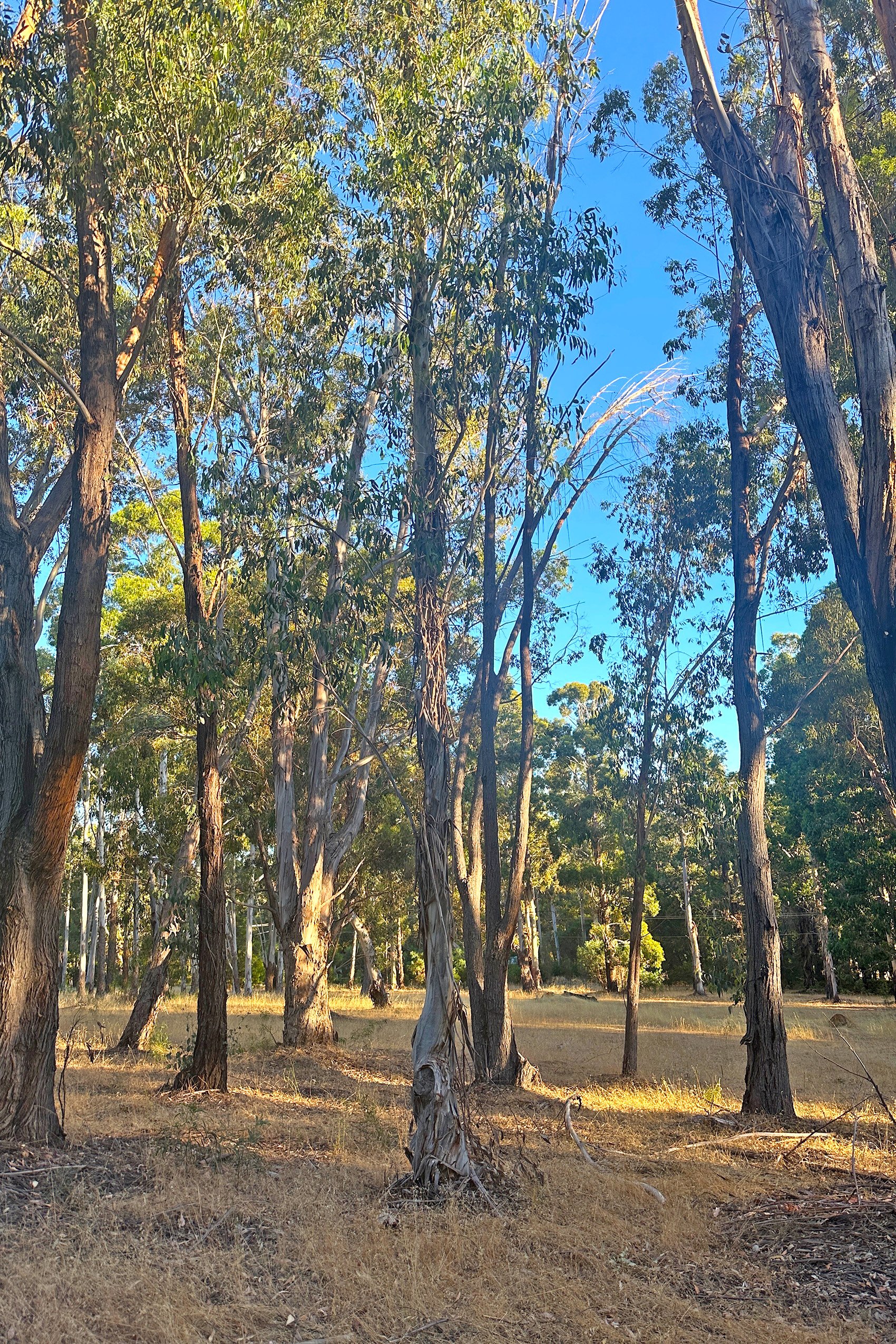
E. pauciflora in the Park
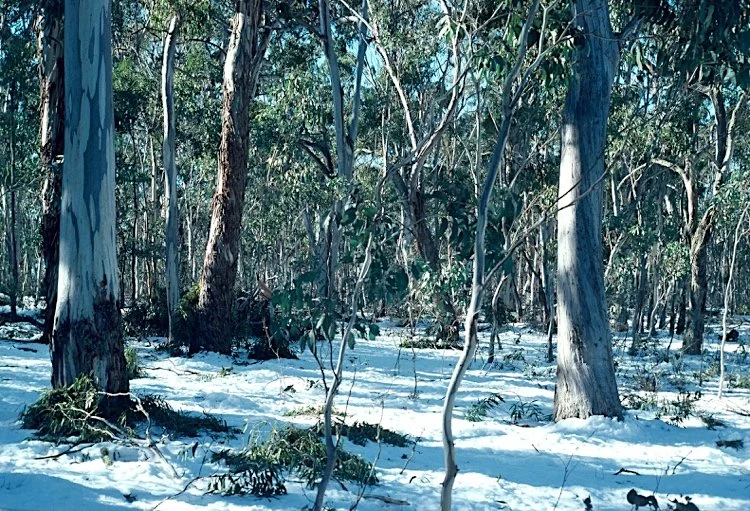
E. pauciflora in the Snow mountains (Source - opposite)