Eucalyptus falcata Silver mallet
Eucalyptus falcata is a mallet tree growing to 15 m tall.
A mallet is a small (usually less than 10m) Eucalyptus tree often found in semi arid areas, which is a similar habitat to the mallees. A mallet differs from a mallee in that a mallet forms a single narrow stem or trunk whereas a mallee forms multi stems.
Unlike mallees, mallets rarely form a lignotuber. This is a woody swelling at the base of the tree below or just above the ground. It contains ‘adventitious’ buds i.e. new buds normally appear much higher in the tree but these ones are a useful adaption that allow the tree to develop new shoots if the top of the plant is breaks off or is burnt.
It occurs naturally in the southern wheatbelt mainly from east of Wickepin to Lake King and south to Jerramungup Its bark is smooth, grey to silvery.
It flowers in December producing creamy white flowers.
Whilst its common name in silver mallet, it is not the only mallet with that common name. The others are E. ornata, E. argyphea, E. purpurata, E. recta and E. rugulata.
The name is dervived from the Latin falcatos, which are curved like a sickle. This is a reference to the shape of some of the crown leaves, although this is a feature common to many eucalypts.
The tree was planted in the Park in 2009.
Sources
EUCLID - Eucalypts of Australia Forth Edition (2020). https://apps.lucidcentral.org/euclid/text/entities/eucalyptus_falcata.htm
Gardner, C. A. (1987). Eucalypts of Western Australia. Perth, Western Australia, Western Australian Herbarium, Department of Agriculture.
Nicolle, N. (2002). "Two new species of silver mallet (Eucalyptus – Myrtaceae) of very restricted distribution in south-western Western Australia." Nuytsia 15(1): 77-83.
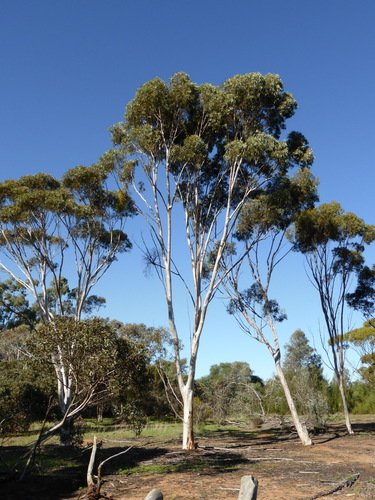
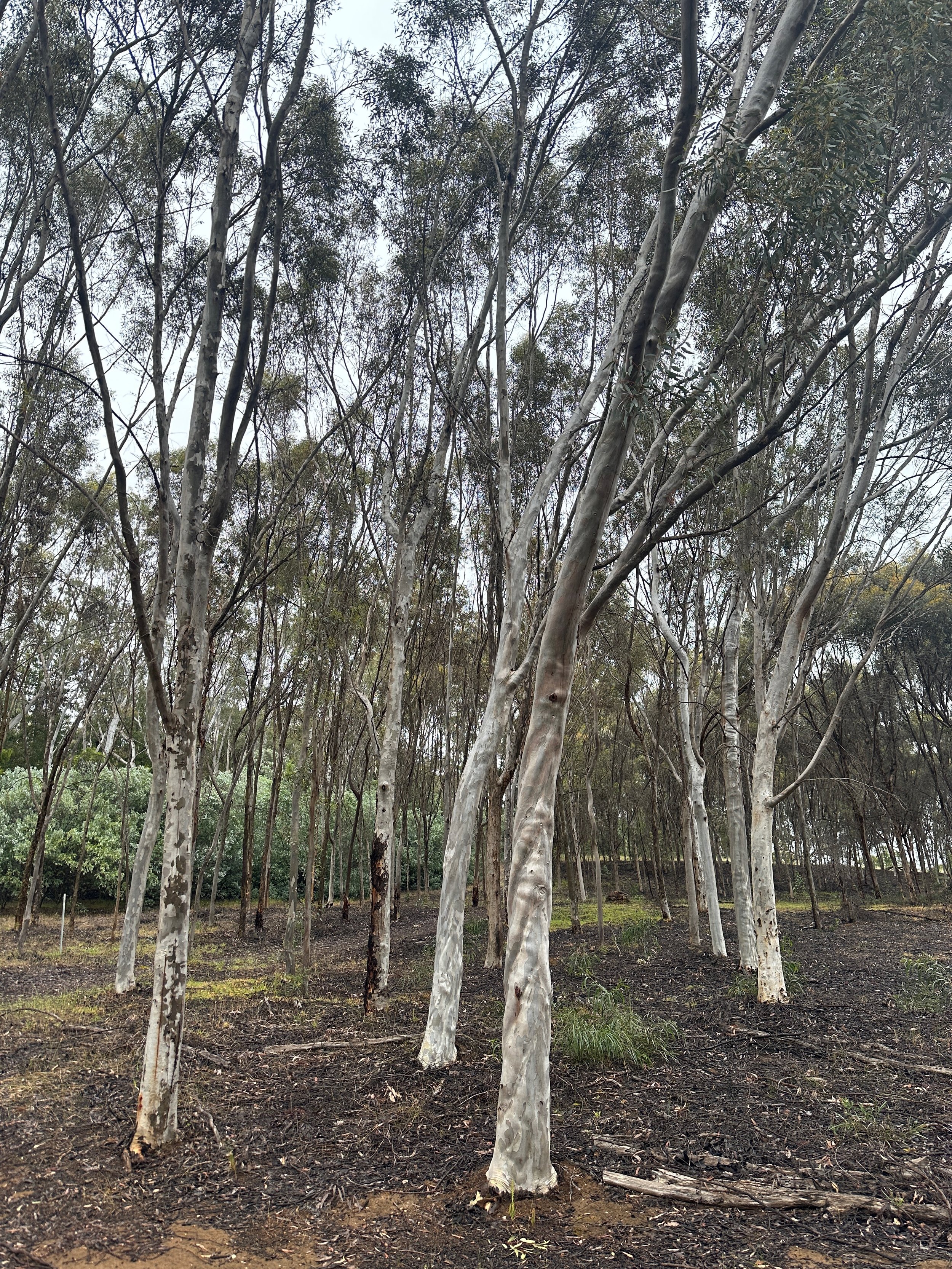
Eucalyptus falcata in the Park